

Home / News / Paving Concepts with Świat Granitu in 5 Simple Steps
Guide · · 7-minute read
Paving Concepts with Świat Granitu in 5 Simple Steps
A driveway, terrace, courtyard, or path made of Swedish granite starts with a good decision, not with a purchase. We’ll show you how to plan a durable surface in five simple steps: from identifying your needs, through selecting the format and color, to calculating the quantity and installation.
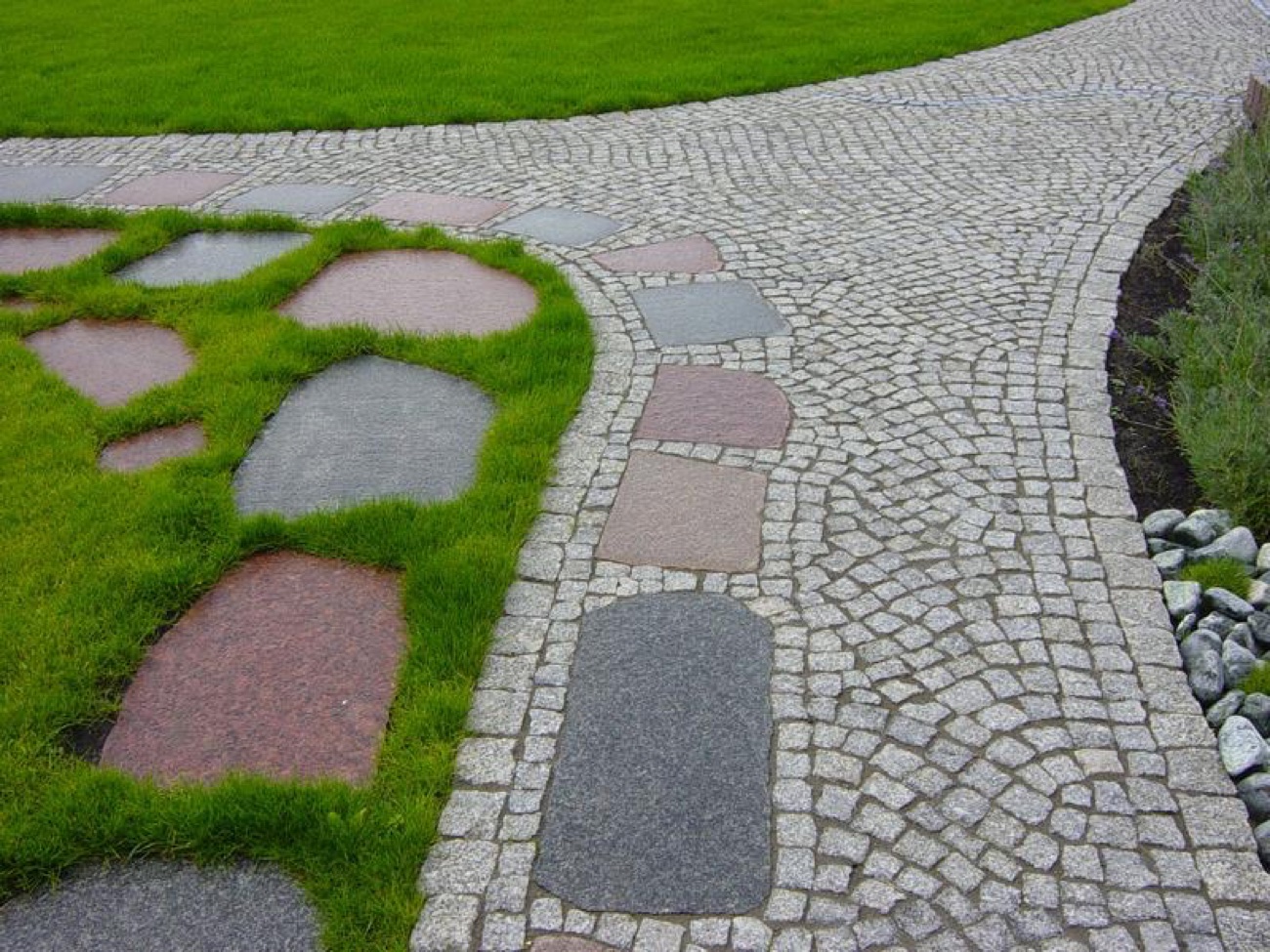
Swedish Granite Paving: Why It's Worth Planning in Phases
Granite is one of the most durable materials that can be used outdoors. Its high hardness, frost resistance, low water absorption, and abrasion resistance mean that a properly installed granite surface will last for generations and requires no renovation. However, this very quality can sometimes lead to mistakes: calibrated pavers and slabs do not forgive errors in planning, so it’s worth breaking down the paving project into its basic components before making a purchase decision.
At Świat z Granitu, a family-owned stonework company that has been in continuous operation since 1988 and is now run by two generations, we begin every project with a conversation, not a price list. Our stone processing plant is located in Reptowo near Szczecin (Kobylanka municipality, West Pomeranian Voivodeship) and is equipped with its own machinery: CNC machines, splitting machines, automatic polishing machines, and workstations for flame-texturing, pebble-texturing, brushing, and sandblasting. This allows us to control every stage of the process, from cutting the block to the final finish.
This guide breaks down the entire process into five steps: 1) needs and location, 2) choosing the format (tiles or slabs), 3) color and surface finish, 4) calculating the quantity in square meters and metric tons, 5) installation and grouting. Each step builds on the previous one, and together they lead to a surface that is functional, safe, and aesthetically pleasing.
Step 1. Need and location: where and why we’re placing the stone
The starting point is the surface’s function, as this determines the choice of material, thickness, and finish. You design a driveway—which a car drives on every day—differently than a patio, where comfort and safety on a wet surface are key, and yet differently still than a representative plaza or a garden walkway. Before choosing a specific product, it’s worth describing the purpose of the space in a single sentence.
For driveways and access surfaces, the load-bearing capacity is the deciding factor: for vehicular traffic, thicker pavers (usually 8 or 10 cm thick) are used, laid on a load-bearing, well-compacted subbase. Walkways and pathways around the house can be made with thinner pavers, while granite slabs laid on a bed of gravel, adhesive, or adjustable supports are often chosen for patios. A city square or courtyard combines both requirements: it must withstand traffic while also looking good.
At this stage, we also collect technical data about the site: the area in square meters, slopes and drainage, any curves and edges, and the proximity to a gate, stairs, or a building facade. The more accurately we describe the location at the outset, the fewer compromises will be necessary later on. For customers in Szczecin and throughout the West Pomeranian Voivodeship, we can carry out this stage based on a design, photos, or on-site measurements.
Step 2. Choosing the format: granite cubes or slabs
Cut (flamed) granite pavers are a premium product featuring geometric precision and smooth edges, with a tolerance of 2 to 5 mm. We manufacture them in thicknesses of 8 and 10 cm (the catalog also includes 6 and 12 cm) and in many sizes: 8×8, 10×10, 15×10, 20×10, 25×10, 15×15, 15×20, and 15×25 cm; non-standard dimensions are available upon request. Thanks to its uniform sides, it can be laid with minimal grout joints, resulting in a clean, modern surface for driveways, plazas, and representative walkways.
Roughly split granite pavers have a rough, naturally non-slip texture and a rustic character. They are available in sizes 4/6, 7/9, 8/11, and 15/17 cm and are ideal for paths, gardens, and areas with a classic look. The product line is complemented by antique pavers (old-style cobblestones), which are aged and come in a mix of Swedish colors, as well as “formak” (20x20x40 cm masonry stone) for edging, palisades, and low walls, which complete the paving composition.
Where large, uniform surfaces are desired, granite slabs are chosen instead of pavers: paving slabs for floors and walkways, terrace slabs for terraces and edging, cladding slabs for facades, and polygonal (irregular, broken) slabs for decorative, natural surfaces. In short: pavers handle traffic, curves, and loads better, while slabs provide a smooth, uniform surface. In a single project, we often combine both solutions—for example, a slab terrace with a paved driveway.
Step 3. Color and Surface Finish
We work primarily with Swedish granite, which is prized for its technical properties and durability. The color palette is wide: Vanga red, the gray-silver and reddish-brown Bohus, the purple-brown Bjärlöv Champagne, the classic Tranås, the black-and-red Gneis Halmstadt, and the exclusive Black Swedish (Moheda). It’s a good idea to choose a color not only based on personal taste, but also to complement the surroundings: the colors of the facade, fence, trim, and landscaping.
The surface finish determines the stone’s safety and appearance. A flamed surface is matte and slip-resistant (resulting from the fire-treatment process); a bush-hammered surface has a regular, rough texture; a sandblasted surface offers a subtle matte finish; and a brushed surface provides a delicate, silky smoothness. Polished and honed finishes are the smoothest and bring out the color most vividly, but for outdoor surfaces—especially wet ones—we recommend non-slip finishes: flamed, bush-hammered, or sandblasted.
There’s a simple rule here: the higher the polish, the more intense the stone’s color. That’s why the same type of granite can look completely different when it’s flamed versus polished. For patios and driveways, matte finishes are most commonly chosen—they provide a safe surface underfoot and for vehicle tires—while a full gloss finish is reserved for decorative elements and interiors. We prepare samples and visualizations of the selected combination prior to production.
Step 4. Calculating quantities: square meters and metric tons
Granite slabs are priced by square meter, so all you need to do here is measure the surface area. Splintered paving stones, on the other hand, are sold by the metric ton, so you need to know their coverage—that is, how many square meters of paving one metric ton provides for a given size. For roughly split cobblestones, the coverage is as follows: 4/6 cm covers about 8 m² per metric ton, 7/9 cm covers about 6 m², 8/11 cm covers about 4.5 m², and 15/17 cm covers about 2.5 m².
Similarly, masonry units are calculated as follows: a 20x20x40 cm block yields approximately 9 running meters of wall or about 1.8 m² of surface area per metric ton. Given the area in square meters and the yield per metric ton, it is easy to calculate the required tonnage. We always add a margin to the result to account for cuts, curves, edges, and natural waste—usually 5 to 10 percent, and slightly more for complex shapes.
It’s a good idea to plan your quantities carefully right from the ordering stage, because purchasing additional batches of natural stone can be troublesome: subsequent deliveries may differ slightly in shade and pattern. At Świat z Granitu, we calculate the quantities in square meters and metric tons for our customers as part of our consulting services and quote preparation. All you need to do is send us the dimensions or your design.
Step 5. Installation and Grouting: Substrate, Grout, Durability
The durability of a granite pavement depends not on the stone itself, but primarily on the subbase. It must be stable, properly compacted, and drained, with the proper slopes maintained. On perfectly calibrated pavers and slabs, any unevenness in the subgrade becomes immediately visible, so this is the foundation of the entire design. Depending on the project, we install the paving on a cement-sand bed, using adhesive (on a load-bearing screed or concrete slab), or on adjustable pedestals, which work well on terraces.
The joint is selected based on the type of material. Cut pavers are laid with a minimal joint filled with a resin (epoxy) grout, which is durable, does not wash out, reduces weed growth, and provides a clean, uniform surface. Split pavers with irregular sides require a wider joint, while slab patios can be grouted with flexible grout or left open using a support system. Regardless of the option chosen, we ensure proper slopes and expansion joints so that water flows freely and the surface can expand and contract without stress.
The best results are achieved when the entire project is entrusted to a single contractor. When the same company selects the materials, manufactures them in its own facility, and handles the installation, the specifications of the pavers, grout, and subbase are consistent with one another, and responsibility for the final result is clear. That’s exactly how we work: comprehensively, from design to installation.
From Design to Installation: Quotes at Świat z Granitu
The five steps—purpose and location, format, color and finish, quantity, and installation—form a complete roadmap for discussing your flooring. You can walk through them with us from the beginning or come with a specific idea, and we’ll finalize the technical specifications and prepare a visualization. We handle both standard and custom projects, with tailor-made production and dimensions tailored to your specific project.
We have been a family-owned stoneworking company since 1988, with a facility in Reptowo near Szczecin, our own machinery, and a full range of services: consulting, selection of Swedish granite, design, production, delivery, and installation. We serve individual customers, contractors, developers, and public projects in Szczecin and throughout the West Pomeranian Voivodeship.
Are you planning a granite driveway, patio, plaza, or walkway? Send us the dimensions or your design, and we’ll prepare a customized quote that includes stone selection, finish options, and a completion date. Call us at +48 513 007 606 or email us at biuro@swiatgranitu.pl. Our facility is located at Reptowo 88B, 73-108 Kobylanka near Szczecin. Give us a challenge—from design to installation.
Frequently Asked Questions
What thickness of granite pavers should I choose for my driveway?
For driveways and entryways for passenger cars, 8- or 10-cm-thick granite pavers are typically used, laid on a load-bearing, well-compacted, and well-drained subbase. Walkways and the paving around the house can be thinner. The final thickness is selected based on the load and the installation method as part of the consultation services offered by Świat z Granitu in Reptowo near Szczecin.
How many square meters of pavement can be laid with one metric ton of split stone?
The yield of roughly split granite cubes from one metric ton is approximately as follows: 4/6 cm size—about 8 m², 7/9 cm size—about 6 m², 8/11 cm covers about 4.5 m², and 15/17 cm covers about 2.5 m². An allowance for trimming and waste, typically 5 to 10 percent, is added to this figure. Granite slabs, on the other hand, are measured in square meters.
Which granite finish is slip-resistant?
For outdoor surfaces, especially those exposed to water, we recommend non-slip finishes: flamed (matte, fire-treated), pebbled, and sandblasted. Polished and honed surfaces are the smoothest and bring out the color most vividly, which is why they work better indoors and on decorative elements than on wet patios and driveways.
What type of grout is used with granite pavers?
Cut (flamed) pavers with smooth edges are laid with a minimal joint filled with a resin (epoxy) grout, which is durable, does not leach out, and reduces weed growth. Roughly split pavers with irregular sides require a wider joint, while slab patios can be grouted with flexible grout or left open on adjustable supports. We always ensure proper slopes and expansion joints.
What type of granite do you use for your paving, and what colors are available?
We primarily use Swedish granite for our paving, which is valued for its frost resistance and low water absorption. Available colors include: Vanga red, gray-ash and red-brown Bohus, purple-brown Bjärlöv Champagne, classic Tranås, black-red Gneis Halmstadt, and Black Swedish (Moheda). The color intensifies with the degree of polish applied to the stone.
Do you have a granite project?
Let's talk.
We’ll help you choose the right stone, color, and finish, and provide a quote. Reptowo near Szczecin · Projects throughout Poland and Europe.