

Home / News / Granite Finishing Methods: Flaming, Bush-Hammering, Polishing
Guide · · 6-minute read
Granite Finishes: Flaming, Bush-hammering, Polishing
The same slab of granite can be a glossy countertop or a rough, safe stair tread. It all comes down to the surface finish. We explain how different textures are created, what effect they produce, and where they’re best used.
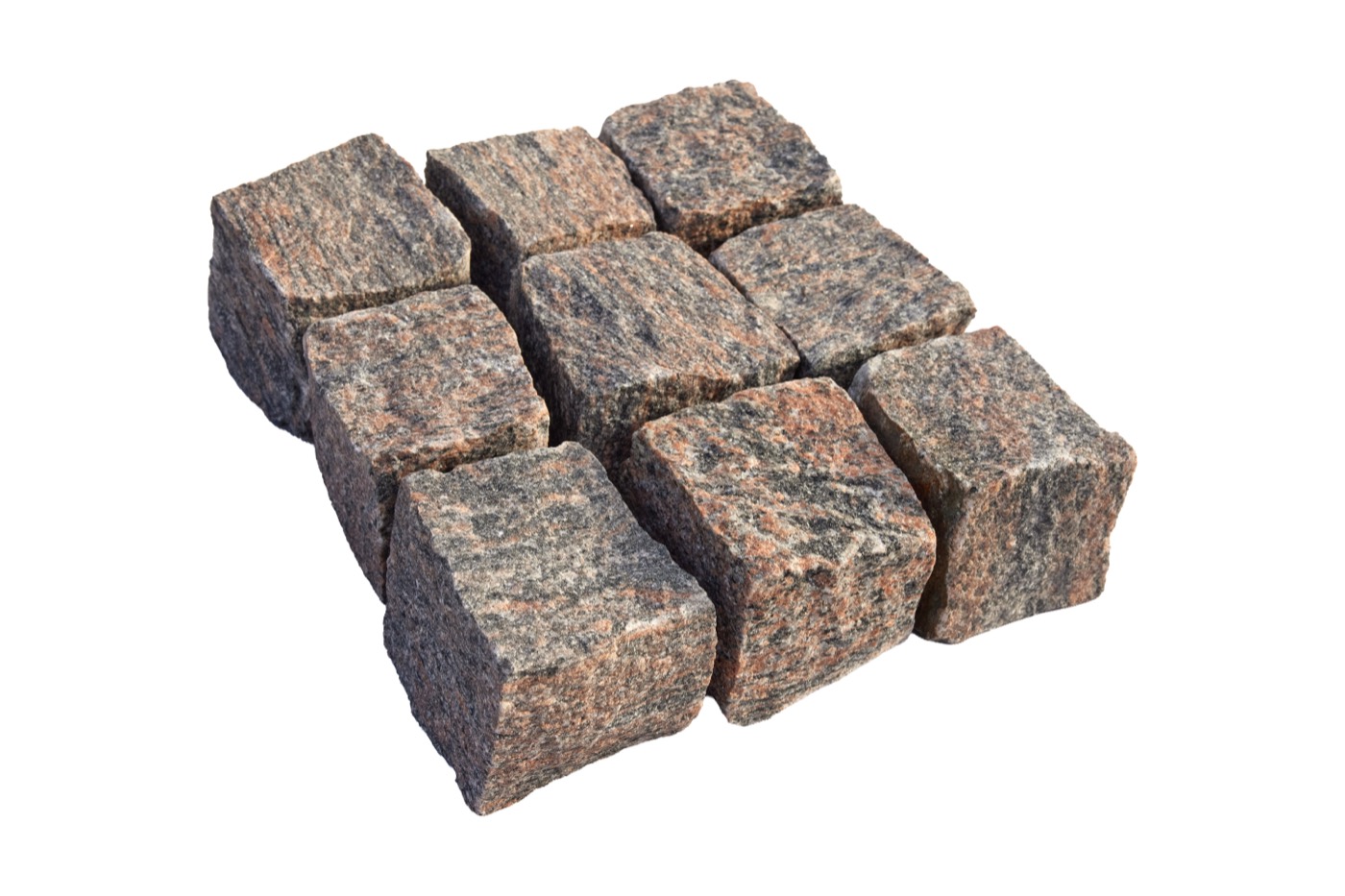
Why the finish of granite is just as important as the stone itself
Granite is an igneous rock with a hardness of 6 to 7 on the Mohs scale and very low water absorption, typically less than 0.5 percent. This is precisely why it has proven itself for decades on building facades, stairs, countertops, and headstones. However, the raw block itself is only half the story. How the surface behaves—whether it will shine or become dull, or whether it will be slippery or rough—depends on the finishing process.
The finish affects three things at once: aesthetics (color depth, gloss, stone pattern), safety (traction, i.e., slip resistance), and practicality (ease of cleaning, resistance to dirt and stains). The same material—for example, red Swedish Vanga granite—can be an elegant, mirror-like countertop in one application and a rugged, safe outdoor stair tread in another.
At Świat z Granitu, a family-owned stonework company in business since 1988, we produce all these finishes at our own facility in Reptowo near Szczecin. We have our own machinery: CNC centers, splitting machines, polishing machines, and a flame-texturing station. This allows us to select the finish not based on what’s currently available, but on what a given project in the West Pomeranian Voivodeship truly requires.
Polishing and Grinding: Luster and Depth of Color
Polishing is a process in which the surface of the stone is smoothed using successive diamond grinding wheels of progressively finer grit, until a mirror-like finish is achieved. The higher the grit (even above 3,000), the more intense the shine. Polishing brings out the color to the fullest and accentuates the natural veining of the minerals, which is why the red of Vanga granite and the deep black of Czarny Szwed (Moheda) granite look most striking after polishing.
Grinding (matte or satin finish) is the same process stopped earlier. The surface is smooth and even to the touch, but it does not reflect light like a mirror. The color is more subdued and muted, and minor scratches and marks are less visible than on a polished surface. This is a good choice when you want an elegant look without the mirror effect.
Applications: Polished surfaces are a classic choice for kitchen and bathroom countertops, windowsills, interior floors, and—in the field of memorial stonework—headstones and memorial slabs, where color depth is important. An important caveat concerns slip resistance: a polished surface, especially when wet, is slippery (approximately class R9); therefore, we do not recommend it for stairs and outdoor patios.
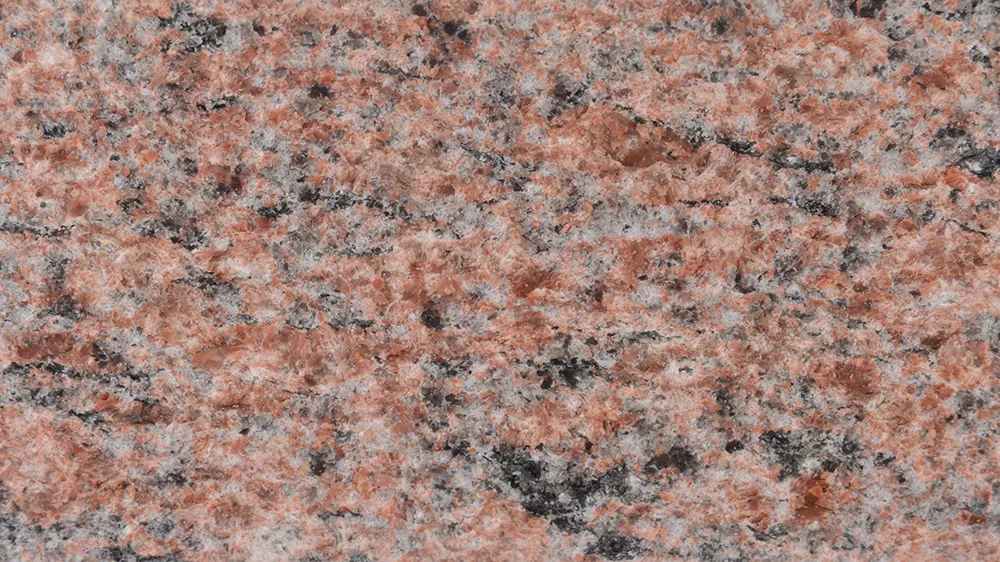
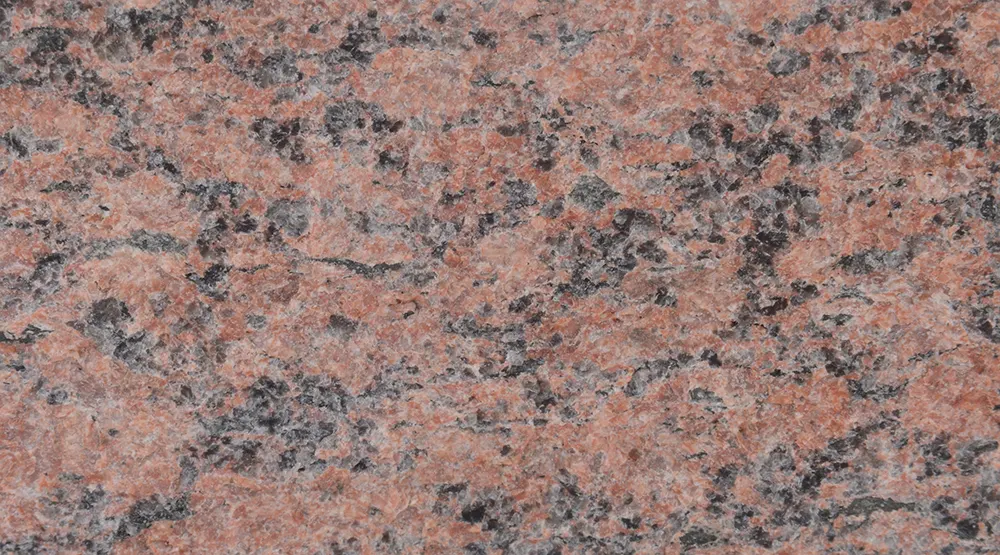
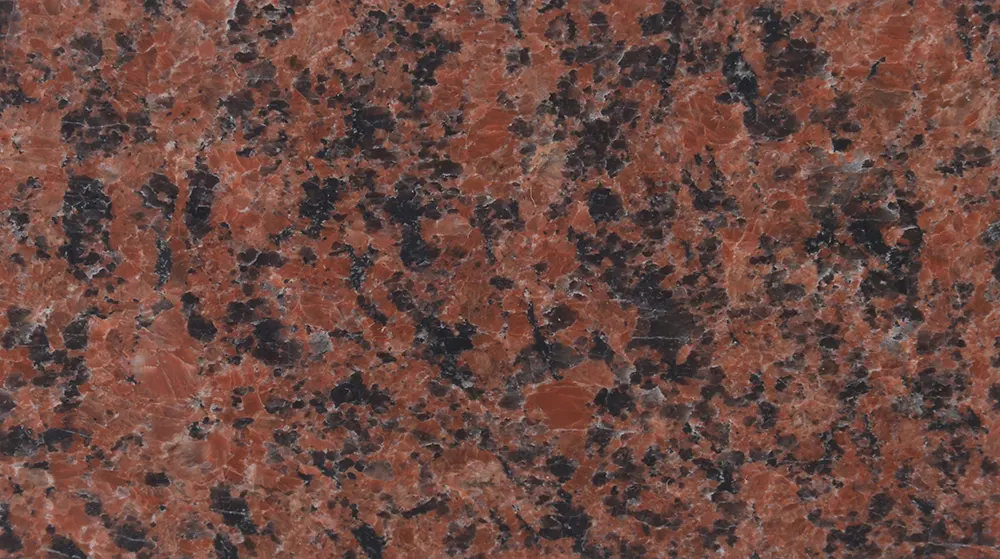
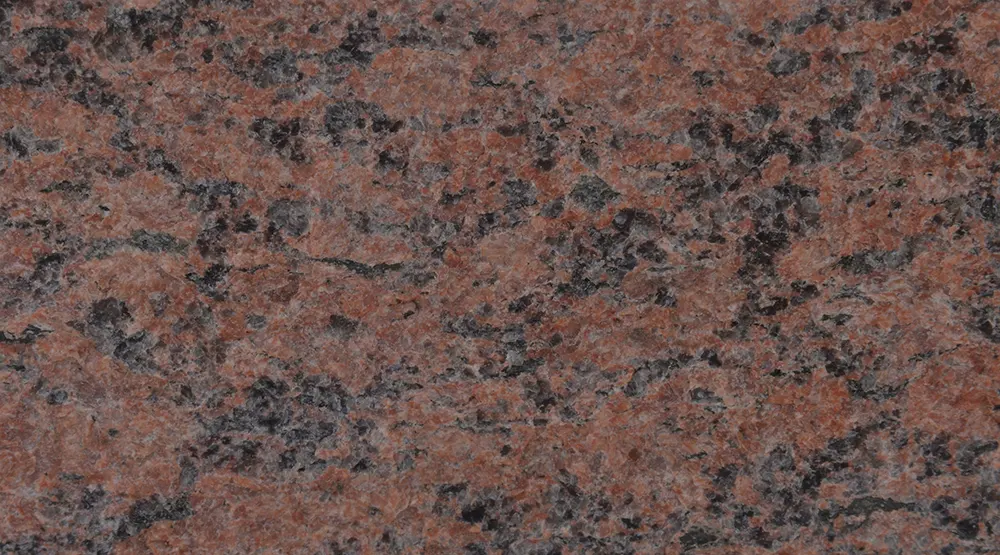
The same Vanga in four finishes—the higher the gloss, the richer the color.
Flame: a non-slip texture designed for use in water and freezing conditions
Flame-texturing is a thermal treatment. The surface of the granite is swept by a burner with a flame reaching approximately 2,000 to 3,000 degrees Celsius, usually fueled by a mixture of gas and oxygen. Different minerals expand at different rates, causing the top layer of the rock to flake off in small scales. This creates a rough, slightly undulating texture with a depth of several millimeters.
Visual effect: The color becomes lighter, more matte, and subdued compared to the polished version, and the surface takes on a natural, raw character. However, traction is the most important factor. A flamed surface is one of the most slip-resistant granite finishes, roughly in the R12 to R13 class (according to the slip resistance classification for footwear), which makes it safe even when wet or icy.
Applications: outdoor stairs, terraces, driveways, pool decking, building perimeters, and plazas. It is also a common finish for the walkable parts of tombstones, such as the base and plinth. Hard, frost-resistant Swedish granite—such as Bohus Gray, Halmstad Gneiss, or Tranås—withstands this wear exceptionally well, and the flamed finish beautifully highlights their texture.
Shot blasting and sandblasting: controlled, uniform surface roughness
Peening is a mechanical finishing process. The surface is treated with a tool called a peening head, which consists of a head with numerous sharp points (formerly a hand-held hammer with needles). This creates a dense grid of fine, regular indentations. The texture is uniform, matte, and pleasantly rough, and the color, similar to flame treatment, becomes lighter. The slip resistance is high, approximately R11 to R12.
Sandblasting involves blasting a surface with a high-pressure stream of abrasive material (such as corundum or garnet sand). This produces a very even, fine-grained, satin-matte texture that feels softer to the touch than peening. Sandblasting is also used to create matte letters, ornaments, and graphics on a polished background, which is a classic technique for decorating headstones.
Application: Sandblasting is ideal for stairs, outdoor flooring, and building facades where reliable, uniform traction and a more rugged aesthetic are required. Sandblasting is primarily used for decorative details and lettering, as well as for creating a matte surface finish that contrasts with the polished surroundings.
Brushing and splitting: a natural, elegant matte finish
Brushing (a finish also known as antique or leather) is performed using a set of diamond and abrasive brushes that smooth out a previously textured or rough surface. The result is a gently undulating, silky-matte surface that is pleasant to the touch and has a slightly muted color. It looks natural and warm, and is moderately slip-resistant, roughly equivalent to class R10. This finish is often combined with other treatments; for example, a previously flame-treated surface is brushed.
Splitting is the most primitive finish. The stone is split along its natural planes using a hydraulic splitter, revealing its raw, irregular texture. The surface is distinctly three-dimensional—stone in the most literal sense—and offers excellent traction. It is a classic finish for masonry elements, cladding, decorative plinths, and garden architectural details.
Application: The brushed finish is chosen by those who want to avoid a mirror-like effect but still value smoothness and a modern, subdued look—for example, on countertops or windowsills. Split-face stone creates a rustic, natural atmosphere: retaining walls, fountains, building facades, edging, and accents in gravestone and garden stonework.
How to Choose a Finish Based on the Application and the Type of Swedish Granite
The practical rule is simple. Indoors and in areas where color depth and an elegant appearance are important, polishing or grinding works best. Outdoors, where water, frost, and the risk of slipping are present, we opt for rough textures: flamed, speckled, or split-face finishes. Brushing and sandblasting offer an elegant middle ground between these two approaches, often used to add detail and contrast.
Slip resistance is best understood in terms of slip resistance classes ranging from R9 (smooth surfaces) to R13 (the roughest). Polishing is approximately R9, grinding and brushing is R10, sandblasting is R10 to R11, shot blasting is R11 to R12, and flame-texturing and splitting are R12 to R13. These values help you plan stairs, a patio, or a floor so that they remain safe year-round.
We also always select the finish to match the specific stone. The Swedish granite that we import and process in Reptów near Kobylanka is renowned for its dense, uniform structure and high frost resistance, making it ideal for outdoor applications. Red Vanga and Bjärlöv Champagne display beautiful color when polished, Gray and brown Bohus, as well as Halmstadt Gneiss, look great when flamed, while Black Swedish (Moheda) makes the greatest impression as a deep, polished black. In memorial stonework, we combine finishes with empathy and care: we usually polish headstones to preserve the depth and legibility of the lettering, while we flame-texture or bush-hammer paving elements to ensure the safety of loved ones visiting the memorial site.
At Świat z Granitu, we manage projects from start to finish—from consultation and design, through custom production using our own machinery, all the way to on-site installation. If you’re planning a countertop, stairs, facade, flooring, or headstone in Szczecin or anywhere in the West Pomeranian Voivodeship, we’ll advise you on the best finish and provide a free estimate. Feel free to contact us: Reptowo 88B, 73-108 Kobylanka, tel. +48 513 007 606, biuro@swiatgranitu.pl.
Frequently Asked Questions
Which granite finish is the most slip-resistant?
Rough textures provide the highest traction: flame-treated and split surfaces (approximately R12 to R13) and pebbled surfaces (R11 to R12). That is why they are recommended for outdoor stairs, patios, and floors exposed to water and frost. A polished surface is the most slippery (approximately R9) and should not be used outdoors.
Is polished granite suitable for outdoor stairs?
We do not recommend this option. A polished surface is beautiful and has deep color, but when wet or icy, it becomes slippery. For outdoor stairs and patios, flamed or bush-hammered granite is a better choice, as it provides safe traction year-round.
What is the difference between grinding and polishing granite?
It is the same process of smoothing with diamond grinding wheels, but stopped at a different stage. Grinding produces a smooth but matte surface with a subdued color and less visible scratches. Polishing continues the process until a mirror-like finish is achieved, maximizing both color and luster.
What finish should I choose for a headstone?
Most often, two finishes are combined. Plaques and memorial slabs are polished to enhance color depth and the legibility of the lettering, while walkway and base elements—which people walk on—are flamed or sandblasted for safety. Inscriptions and ornaments are often created using a sandblasting technique on a polished background.
Does the finish change the color of the granite?
Yes. Polishing deepens and enriches the color and highlights the mineral patterns. Rough textures, such as flamed, bush-hammered, or sandblasted finishes, lighten and dull the surface, giving the stone a more natural, subdued hue. The same block can therefore look completely different depending on how it is finished.
Do you have a granite project?
Let's talk.
We’ll help you choose the right stone, color, and finish, and provide a quote. Reptowo near Szczecin · Projects throughout Poland and Europe.