

Home / News / Granite Pavers: Cut, Roughly Split, or Masonry Stone? How to Choose
Guide · · 7-minute read
Granite pavers: cut, rough-split, or masonry stone? How to choose
Flame-cut, rough-split, or masonry-cut? We explain the differences between these types of granite pavers, how many meters you get per metric ton, and when to choose which type for a driveway, patio, or walkway.
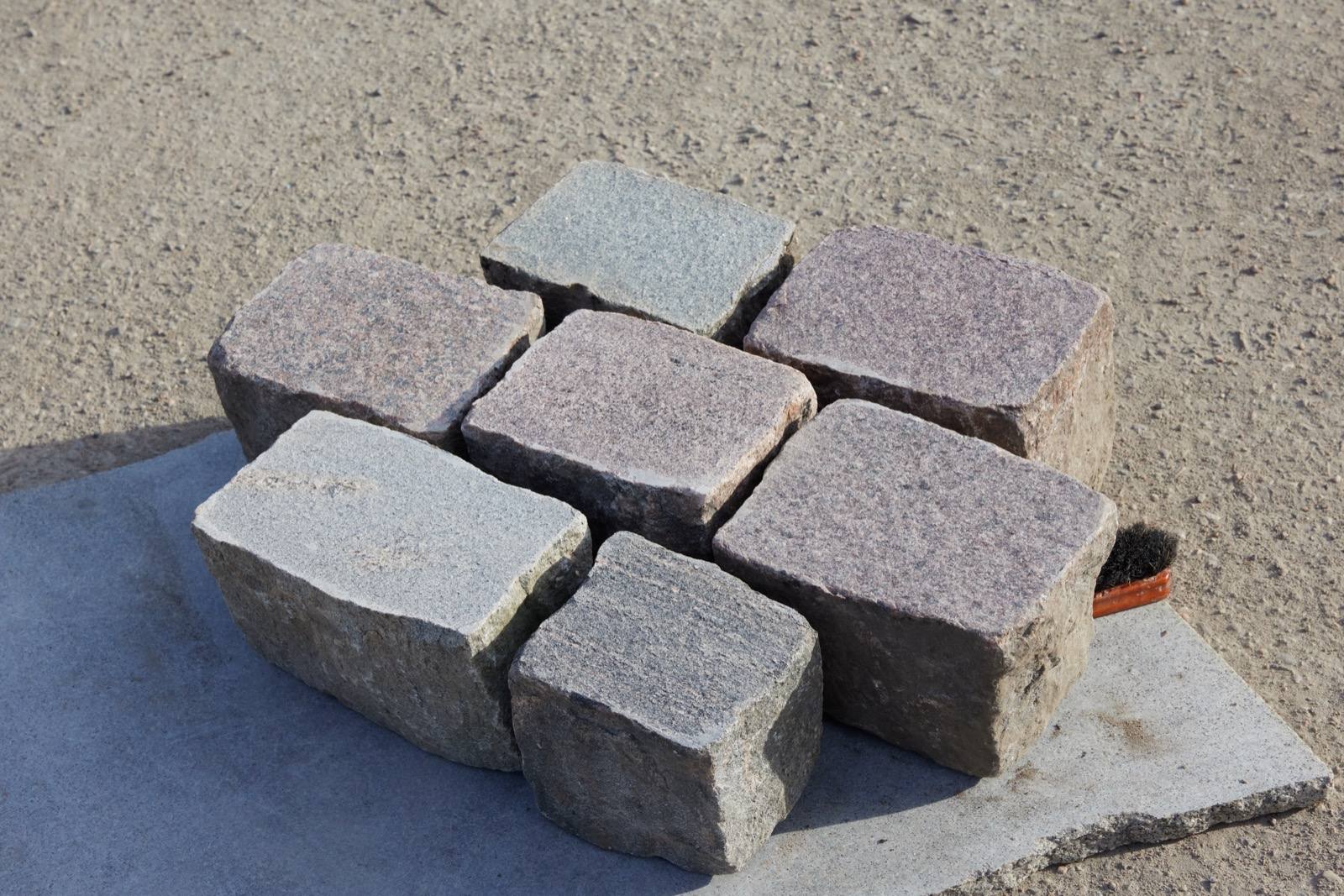
Three Types of Granite Pavers: How Do They Differ?
Granite pavers are not a single product, but rather a whole family of elements that vary in terms of finishing, geometry, and intended use. Most often, the choice comes down to three options: cut pavers (usually flame-treated on top), rough-split pavers, and formak, or masonry stone. Each has a distinct visual character, varying dimensional consistency, and different yield per metric ton, so it’s best to start by considering where and how the pavement will be used.
A cut paver is a stone with regular edges, cut on saws and then usually flame-treated on the face. It produces even, distinct joints and a consistent surface pattern. Roughly split pavers are created by splitting granite, so they have natural, irregular sides and a rustic character, along with a distinctive rough texture. Formak and masonry stone, on the other hand, are rectangular or block-shaped elements intended primarily for low walls, edging, outdoor stairs, and retaining walls, although larger sizes are also sometimes used as pavers for representative surfaces.
All three have one thing in common: granite. It is an igneous rock characterized by extremely high hardness, low water absorption, and resistance to frost and road salt, which is why it performs well in the Polish climate and in the conditions of Western Pomerania, where road surfaces are subjected to freeze-thaw cycles throughout the winter.
Cut and Flamed Paving Stones: Consistency and Premium Elegance
Cut pavers are the choice for those who value order and precision. Thanks to saw-cutting, the sides are even and the dimensions are consistent, resulting in narrow, uniform joints and a clear pattern—such as herringbone, rows, or arches. The top surface is most often flamed: under the influence of a high-temperature torch, the outer layer of the stone chips away, creating a fine-grained, matte, and rough texture. The result is a surface that is both elegant in appearance and slip-resistant.
This type of paving stone is ideal for areas where premium aesthetics are a priority: driveways in front of single-family homes, prestigious entrances, borders around buildings, terraces, courtyards, and surfaces at commercial properties. The regular geometry also makes it easy to combine the pavers with granite slabs featuring the same finish, allowing you to design a cohesive whole: a terrace made of slabs and a driveway made of pavers in a single stone color.
A stone masonry company offers cut pavers in many sizes, ranging from small pieces measuring 4×6 cm, through the popular 8×10 and 9×11 cm sizes, to larger modules. The smaller the paving stone, the easier it is to lay arches and curves; the larger the stone, the faster large surfaces can be installed. In addition to flame-texturing, the surface can also be ground, polished, speckled, brushed, or sandblasted, allowing you to choose the texture that best suits the project and the required roughness.
Rough-split cobblestone: natural, slip-resistant, versatile
Roughly split pavers are a classic found on every city sidewalk and driveway. They are made by splitting granite, which is why their sides are irregular and their top surface is naturally rough. This roughness has two practical advantages: very high surface roughness—providing genuine slip resistance even on slopes and wet surfaces—and a visually forgiving appearance, as slight variations in size and shade blend into the rustic pattern.
This is a versatile and highly durable solution. It works well on driveways with heavy vehicle traffic, on garden paths, around swimming pools, on walkways leading to the house, in courtyards, and in areas where durability and walking safety are essential. Due to its irregular edges, split pavers are laid with a slightly wider joint than cut pavers, which further enhances the natural, stone-like effect.
The most popular sizes for split pavers are 4×6 cm, 5×7 cm, 8×11 cm, and the large 15×17 cm. Small cubes are ideal for patterns, arches, and pedestrian areas, while larger ones are suitable for high-traffic driveways. In Swedish granite varieties—such as red Vanga, gray or brown Bohus, or Black Swedish—the split texture further enhances the depth of color and the stone’s natural structure.
Pavers and masonry blocks: more than just paving
A Formak, also known as a masonry block, is a larger, block-sized element designed primarily for vertical construction and for finishing edges. Formaks are used to build garden walls, retaining walls on sloped lots, borders for flower beds and driveways, posts, fence footings, and outdoor stairs. It is the same durable granite, but used in a different role: for structural and finishing purposes, rather than solely as a paving material.
Masonry stone is sometimes split on the visible faces, creating a rough, natural wall with a distinctive texture, or cut and finished when the design calls for smoother, more geometric lines. Larger blocks, for example, with sides measuring a dozen or so centimeters, also serve as massive paving stones for heavy-duty surfaces or for prestigious squares where a solid, stone-paved look is desired.
In design practice, Formak most often complements paving stones: the same granite color scheme used in the retaining wall, edging, and paving creates a cohesive composition for the garden and the home’s surroundings. This allows you to design the driveway, stairs, retaining wall, and edging all from a single material, maintaining a uniform look for the entire property.
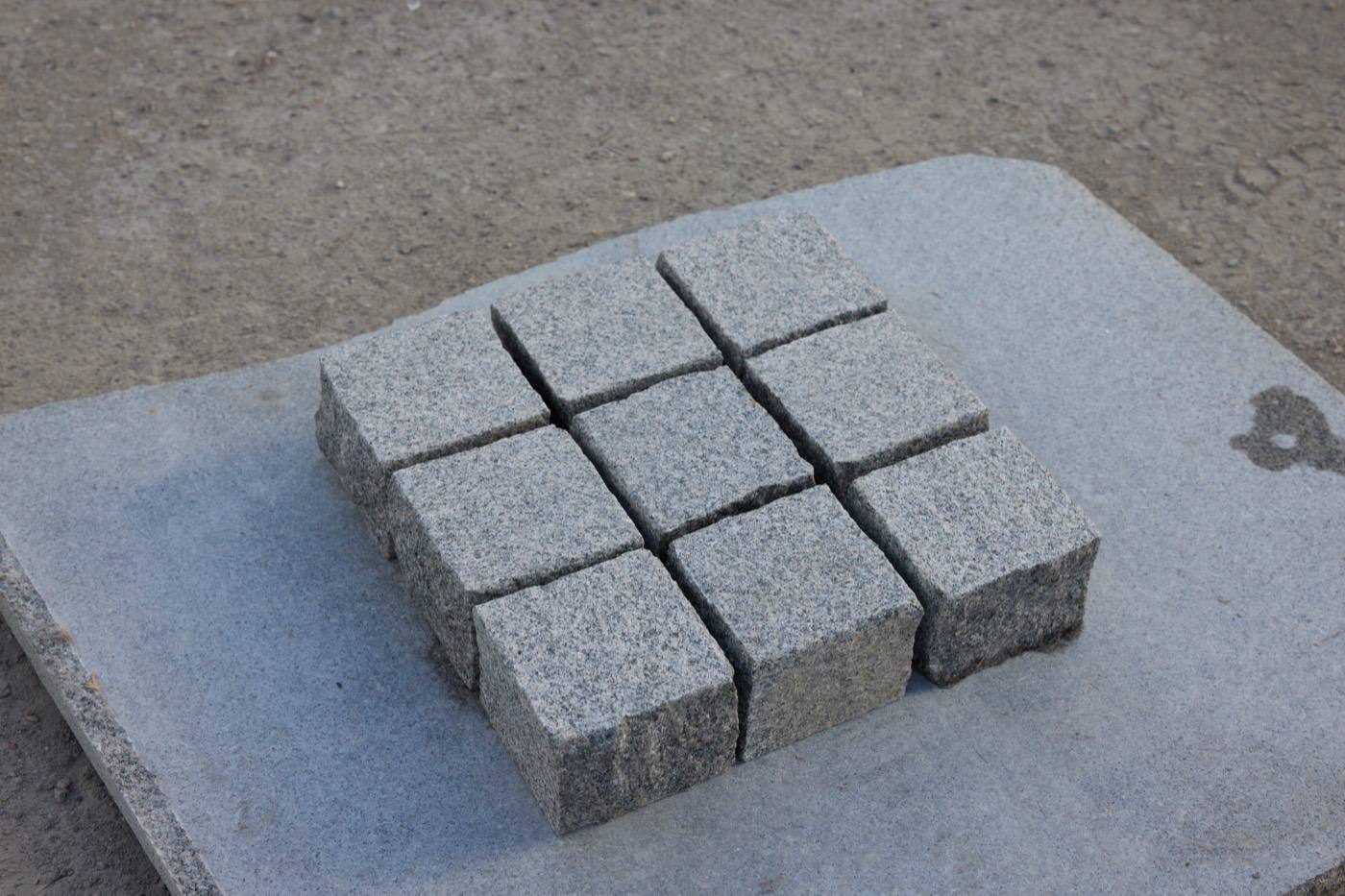
Yield per metric ton: How many blocks do you actually need?
Granite pavers are most often purchased by weight, so it’s crucial to calculate how many square meters of paving surface one metric ton will yield. Coverage depends on the height of the paver: the taller the paver, the greater its mass per square meter and the smaller the area covered by one metric ton. Granite has a density of approximately 2.7 metric tons per cubic meter, which allows you to estimate actual consumption.
Approximate coverage per metric ton for granite pavers: · 4/6 cm: approximately 6 to 7 m² · 5/7 cm: approximately 5 to 6 m² · 8/11 cm: approximately 3.5 to 4 m² · 15/17 cm: approximately 2 to 2.3 m². These figures are approximate, as actual consumption depends on the thickness of the base layer, the width of the joints, the type of paving stones (split stones are used slightly differently than cut stones), and waste from trimming along edges and patterns.
When planning your purchase, it’s a good idea to add a margin—usually between 5 and 10 percent—to account for cuts, curves, and any future replacements. It’s also good practice to order the entire quantity from a single batch of material to ensure a uniform stone color. If in doubt, it’s best to send the dimensions or a design of the surface; this makes it easy to calculate the exact tonnage and prepare a quote tailored to the specific project.
How to Choose the Right Paving Stone for Your Project: A Simple Guide
Garage driveway and vehicle access: load-bearing capacity and safety are key here. Roughly split pavers measuring 8/11 or 15/17 cm are a good choice, as they provide excellent slip resistance, or flame-cut pavers if you’re looking for a more elegant, even pattern while maintaining a rough surface texture.
Patio, walkway around the house, and courtyard: cut and flamed pavers in smaller sizes work best, as they create a visually smooth, elegant surface and blend easily with granite slabs. Garden paths and walkways: small split pavers measuring 4/6 or 5/7 cm allow you to create gentle curves and natural, irregular patterns that blend seamlessly into the greenery.
Areas around the pool and on slopes: Roughly split pavers are naturally slip-resistant, which improves safety in wet conditions. Low walls, edging, outdoor steps, and retaining walls: this is where formwork and masonry stone come into play, ideally in the same granite color scheme as the paving to create a cohesive overall design. If you’re unsure, technical advice and selecting the right format for a specific project are standard parts of working with a stone masonry shop.
Swedish granite and custom manufacturing in Reptowo near Szczecin
Świat z Granitu is a Polish, family-owned stone masonry company that has been in business since 1988 and is now run by two generations. We specialize in Swedish granite, which is prized for its uniform texture, distinctive color, and exceptional durability. Our product range includes, among others, red Vanga, gray and brown Bohus, Bjärlöv Champagne, Halmstadt Gneiss, Black Swedish (Moheda), and Tranås, allowing you to select pavers and masonry stone to match any color scheme for your garden and exterior walls.
We have our own machine park: CNC machines, splitting machines, polishing machines, and flame-texturing stations. This allows us to offer custom manufacturing, and we tailor surface finishes to your needs: flame-treated, peened, polished, ground, brushed, sandblasted, and split. We offer comprehensive services, from design and material selection, through machining, to on-site installation.
The facility is located in Reptowo near Szczecin, in the municipality of Kobylanka, in the West Pomeranian Voivodeship, which allows us to serve Szczecin and the entire region. If you’re planning a driveway, patio, walkway, low wall, or edging made of granite and want to choose the right type of pavers and calculate the exact tonnage, please contact us at: Reptowo 88B, 73-108 Kobylanka, phone +48 513 007 606, email biuro@swiatgranitu.pl. We’ll prepare a quote tailored to your project.
Frequently Asked Questions
Which granite paver is best for a garage driveway?
For a driveway with heavy vehicle traffic, rough-split pavers in the 8/11 or 15/17 cm sizes work best, as they are very durable and naturally slip-resistant. If you’re looking for a more elegant, uniform appearance, a good choice is cut and flamed cobblestone, which retains a rough surface texture while providing consistent, narrow joints.
How does flame-cut cobblestone differ from rough-split cobblestone?
Sawn pavers have regular, saw-cut sides and, most often, a flamed top, which results in even joints and a consistent, attractive surface pattern. Roughly split pavers are produced by splitting granite, so they have irregular sides, a natural, rustic appearance, and a very high degree of roughness. Cut pavers are more elegant and precise, while split pavers are more natural and versatile.
How many square meters of paving can be made from one metric ton of granite pavers?
Coverage depends on the size of the pavers. As a rough estimate, one metric ton will cover: 4/6 cm pavers—about 6 to 7 m²; 5/7 cm pavers—about 5 to 6 m²; 8/11 cm pavers cover approximately 3.5 to 4 m², and 15/17 cm pavers cover approximately 2 to 2.3 m². The taller the paver, the smaller the coverage per metric ton. It’s a good idea to add 5 to 10 percent extra for cutting.
Are granite pavers slip-resistant?
Yes. Rough-split pavers are naturally slip-resistant due to their rough, split surface, which is why they work well on slopes, around pools, and on wet surfaces. Cut pavers achieve their slip resistance through flame-texturing, which creates a fine-grained, rough, and matte surface texture.
What are formak and masonry stone?
Formak, or masonry stone, is a granite element with larger, block-like dimensions, intended primarily for garden walls, retaining walls, edging, outdoor stairs, and fence footings. It can have a split or cut face. It is best to choose a color that matches the granite used for the paving so that the entire area surrounding the house forms a cohesive composition.
Do you have a granite project?
Let's talk.
We’ll help you choose the right stone, color, and finish, and provide a quote. Reptowo near Szczecin · Projects throughout Poland and Europe.